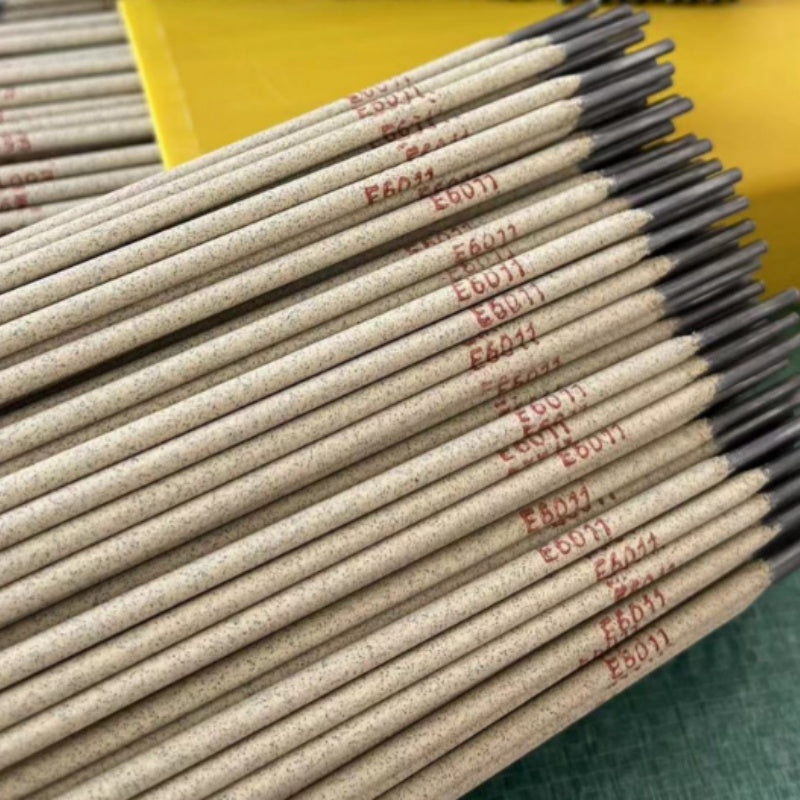




E7018 Isn’t Universal! E7014 Is More Cost-Effective in 3 Scenarios
hen new welders start out, they often hear, “E7018 is a universal welding rod—just buy it, and you can’t go wrong.” But in practice, they realize: after costing several hundred dollars on E7018, the rod absorbs moisture because they don’t have an oven, leading to welds full of porosity; a slight mistake in current adjustment causes slag inclusion or burn-through; finally, the E7018 ends up collecting dust in the corner, it’s a total waste of money!
In fact, for new welders without professional equipment or experience, E7014 is more practical than E7018.Today, we’ll compare these two rods from three core dimensions—storage cost, ease of operation, and applicable scenarios—to help you avoid the trap of “following the trend to buy expensive rods.” This is especially useful for home repairs, small workshops, and other scenarios without an oven.
STORAGE COST:E7018 "BURNS MONEY",E7014 "SAVES MONEY"
The most easily overlooked cost for new welders is rod storage. As a low-hydrogen rod, E7018 has much stricter storage requirements than E7014. Without equipment, you’ll not only waste money but also ruin the rod.
E7018:NO OVEN=A WASTED EXPENSE
According to industry standards (e.g., AWS A5.1), E7018 must be stored in an environment with humidity ≤40% and temperature 10–25°C; otherwise, the flux will absorb moisture quickly. Without a professional oven, new welders face two problems:
- Moisture-absorbed E7018 must be re-dried (350–400°C for 1–2 hours). However, E7018 can be dried at most twice. Exceeding this number oxidizes alloy elements in the flux, reducing weld strength by 10–15%;
- Using it without drying increases weld porosity from 2% to over 15%, making the weld useless and leading to higher rework costs.
E7014:STORES IN ORDINARY ENVIRONMENTS,NO EXTRA COST
Unlike low-hydrogen E7018, E7014 is a rutile-calcium rod with relaxed storage requirements:
- It works in environments with humidity ≤60% and temperature 5–30°C—no special storage needed; a balcony or cabinet at home (as long as it’s not damp) works fine;
- After opening the package, it won’t absorb significant moisture even if left for 1–2 weeks. No oven or dryer is required, which is “wallet-friendly” for new welders.
Storage Cost Comparison Table
| Comparison Item | E7018 (Low-Hydrogen) | E7014 (Rutile-Calcium) | New Welder Advantage (E7014) |
| Required Equipment | Professional oven | None | Saves equipment costs, no space needed |
| Storage Humidity Requirement | ≤40% | ≤60% | Adapts to home/small workshop environments |
| Handling After Moisture Absorption | Must be dried (350–400°C) | No drying needed (usable after short exposure) | Saves time, avoids rod waste |
| Annual Extra Cost | oven + electricity | None | More cost-effective long-term |
EASE OF OPERATION:E7018 "FUSSY",E7014 "FORGIVING"
For new welders, the biggest problems are “losing control of the arc” and “struggling to remove slag.” E7018 demands high skill with low fault tolerance, while E7014 acts like a “new welder coach”—even with unpolished techniques, you can still produce qualified welds.
E7018:A SMALL MISTAKE CAUSES DEFECTS
E7018’s low-hydrogen flux is strict about current, angle, and base metal cleaning—new welders easily make mistakes:
- Narrow current range: For the commonly used 3.2mm diameter, E7018’s optimal current is 90–110A. Current below 90A causes slag inclusion; above 110A makes the flux peel off early, destabilizing the arc;
- High base metal cleaning demands: If the base metal has rust or oil (a detail new welders often ignore), E7018 produces dense porosity. New welders rarely have the patience to fully grind the metal;
- Difficult slag removal: The slag from low-hydrogen flux has strong adhesion. New welders spend ages hitting it with a hammer, leaving residues that affect subsequent welding.
E7014:NEW WELDERS CAN "WELD SUCCESSFULLY ON THE FIRST TRY"
E7014’s rutile-calcium flux is inherently “easy to use,” perfectly matching new welders’ unskilled techniques:
- Wide current tolerance: For the same 3.2mm diameter, E7014’s current range is 80–120A (30% wider than E7018). Even slight current deviations won’t cause major issues;
- Stable arc, no sticking: Titanium in the flux extends arc duration. If a new welder’s hand shakes and the rod moves slightly away from the base metal, the arc won’t extinguish easily;
- Slag falls off with a tap: Rutile-calcium flux produces brittle slag. After welding, a light tap with a slag hammer removes it—no time wasted on cleaning.
Ease of Operation Comparison Table (3.2mm Diameter)
| Operation Detail | E7018 | E7014 | New Welder Friendliness (E7014) |
| Optimal Current Range | 90–110A (narrow) | 80–120A (wide) | High fault tolerance, no repeated current adjustments |
| Arc Stability | Easy to extinguish (shakes break the arc) | Stable (arc stays even with slight distance) | Reduces frustration from “arc break mid-weld” |
| Base Metal Cleaning Requirement | Must be fully ground (no rust/oil) | Minor rust acceptable (easy for new welders) | Saves pre-treatment time |
| Slag Removal Difficulty | Hard (strong adhesion, needs forceful tapping) | Easy (light tap to remove) | No struggling with slag |
| First-Time Pass Rate for New Welders | ~50% (prone to porosity/slag) | ~85% (few defects) | Builds welding confidence quickly |
APPLICABLE SCENARIOS:E7014 IS MORE COST-EFFECTIVE IN THESE 3 CASES
For scenarios new welders often encounter—home repairs, small workshops, and outdoor temporary welding—E7014’s “cost-effectiveness” far surpasses E7018. It’s not just “good enough”; it also avoids the waste of “overkill.”
HOME REPAIRS:E7014 WORKS FOR FURNITURE/METAL FIXES
Common home welding needs include:
- Welding bicycle frames or iron flower stands;
- Patching small cracks in stainless steel sinks;
- Reinforcing metal connectors for wooden furniture.
These scenarios don’t require extreme crack resistance (E7018’s core advantage), and E7014 still has a tensile strength of 70,000 psi (same as E7018)—more than enough to handle household loads (e.g., a bicycle frame bears ≤500N, far below the weld’s limit). Most importantly: no pre-drying is needed—open the package and weld. Slag removal is fast, so you won’t delay repairs.
SMALL WORKSHOPS(NO OVEN):E7014 SAVES COSTS OF SHELVES/TOOLS
Many new welders run small workshops (e.g., hardware processing, simple farm tool manufacturing) without budgets for ovens. Here, E7014 is a “must-have”:
- For making 1.2m-tall metal shelves, E7014 welds butt joints without worrying about moisture absorption mid-weld;
- For processing metal handles for simple wrenches or pliers, E7014 produces less spatter, reducing post-welding grinding and boosting efficiency.
In contrast, without an oven, E7018 requires borrowing equipment for drying before each use—not just troublesome, but also risky: incomplete drying can cause shelf welds to crack, leading to rework.
OUTDOOR TEMPORARY WELDING:E7014 WELDS IN WIND—E7018 CAN'T
New welders occasionally need outdoor repairs (e.g., fences, farm machinery parts). Here, E7014’s advantages shine:
- Rutile-calcium flux has better wind resistance than E7018. In outdoor wind speeds ≤2m/s, E7014 maintains over 85% arc stability;
- No heavy oven needed—just bring a box of rods to finish the repair. E7018, however, absorbs moisture easily outdoors, resulting in weak welds.
New Welder Scenario Selection Table
| Scenario Type | Recommended Rod | Core Reason | Operation Notes |
| Home Repairs (Bicycles, Flower Stands) | E7014 | Easy storage, simple operation, sufficient strength | Wipe oil off the base metal (no full grinding needed) |
| Small Workshops (No Oven, Shelf-Making) | E7014 | Saves equipment costs, high fault tolerance, efficient | Use 3.2mm diameter, control current at 90–100A |
| Outdoor Temporary Welding (Fences, Farm Machinery) | E7014 | Good wind resistance, no drying, ready-to-use | Weld in sheltered areas; avoid rainy conditions |
| Professional Structural Parts (Pressure Vessels, Bridges) | E7018 | Low-hydrogen crack resistance for high-strength, high-demand scenarios |
Must store in an oven; fully clean base metal before welding |
FAQ for New Welders
Is E7014 as strong as E7018? Will it be weak?
Both have a tensile strength of 70,000 psi (per AWS A5.1). The loads from home repairs or small workshop products are far below the weld’s bearing limit—more than enough. Only when welding low-temperature/high-pressure structural parts (e.g., liquefied gas cylinders) do you need E7018’s low-hydrogen crack resistance.
I don’t have an oven—can I dry E7018 in the sun to prevent moisture?
Absolutely not! Sunlight only raises surface temperature, not controlling humidity. Moisture-absorbed E7018 has excessive hydrogen content, leading to cold cracks after welding. Without an oven, E7014 is safer—no hassle with moisture prevention.
Can E7014 weld thicker steel plates, like 5mm iron?
Yes! Use a 3.2mm E7014 and adopt “multi-layer welding” (2–3 layers) with 80–100A per layer to fully penetrate 5mm steel. New welders don’t need to “weld through in one pass”—layered welding is easier to control with fewer defects.
I heard E7014 slag sticks to stainless steel easily—Is that true?
Minor slag adhesion is normal, but it’s much easier to remove than E7018’s slag. After welding stainless steel, tap the slag lightly (after ~30 seconds, before it fully cools) to remove it. If it sticks tightly, a quick grind with an angle grinder works—even new welders can do it.
I want to advance to welding structural parts later—should I practice with E7014 or E7018 first?
Start with E7014! It helps you master basic skills like “arc control and current adjustment.” Once proficient, learn low-hydrogen welding with E7018 for a steadier progression. Jumping straight to E7018 often leads to frustration due to its difficulty, discouraging you from continuing.